
Introduction
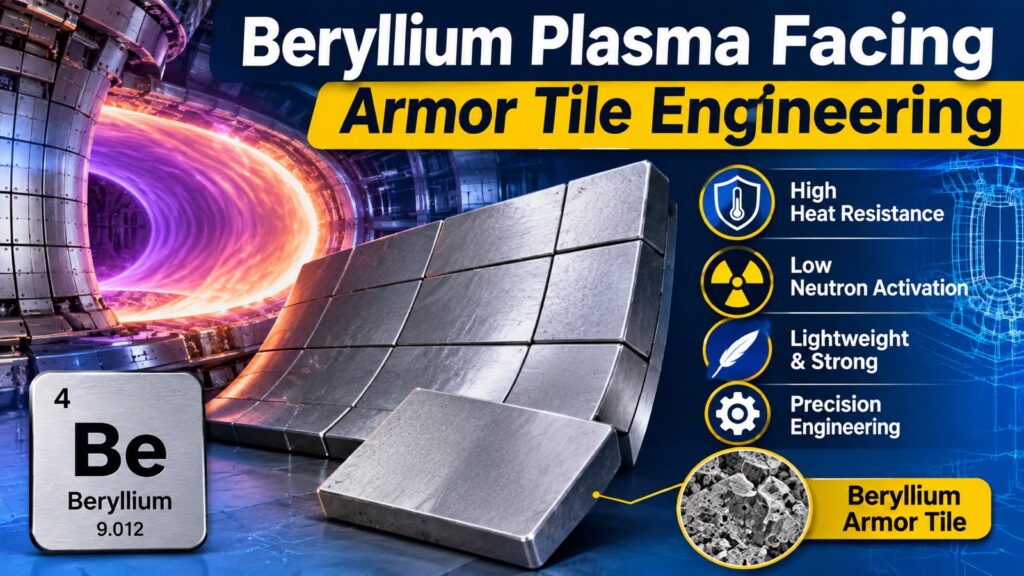
Beryllium plasma facing armor tile engineering is an important area of materials science and fusion reactor technology. As researchers work toward developing practical nuclear fusion energy, protecting reactor components from extreme temperatures, intense particle bombardment, and thermal cycling has become a major engineering challenge. Beryllium has attracted considerable attention as a plasma-facing material because of its low atomic number, relatively low density, and favorable thermal properties.
In magnetic confinement fusion devices, plasma-facing armor serves as a protective barrier between the extremely hot plasma and the underlying structural components. Engineering these protective tiles requires careful consideration of thermal conductivity, mechanical strength, radiation exposure, joining techniques, and long-term material performance.
Beryllium plasma facing armor tile engineering combines advanced materials research, precision manufacturing, thermal analysis, and nuclear engineering. Understanding these elements is essential for evaluating the material’s role in fusion experiments and the development of future energy systems.
Understanding Beryllium Plasma-Facing Armor
What Is Beryllium Plasma-Facing Armor?
Beryllium plasma-facing armor consists of specially engineered protective components designed to withstand the demanding environment inside certain magnetic confinement fusion devices. These components are positioned between the plasma and more vulnerable reactor structures.
Beryllium has several properties that make it attractive for selected plasma-facing applications. Its low atomic number helps limit radiative energy losses when small quantities enter the plasma. It also has relatively high thermal conductivity and a comparatively low density, making it suitable for applications where heat transfer and component mass are important.
However, beryllium is not suitable for every fusion environment. Its toxicity, susceptibility to certain damage mechanisms, and limited tolerance of extreme thermal conditions require careful engineering and stringent safety controls.
Why Plasma-Facing Armor Matters
Fusion plasmas operate at temperatures far exceeding those found in conventional industrial equipment. Although magnetic fields confine the plasma, energetic particles and radiation still transfer substantial heat to surrounding surfaces.
Without effective plasma-facing armor, excessive thermal loading can damage structural components, increase contamination, and shorten experimental operating periods.
Engineered armor tiles help address these challenges by providing a replaceable protective surface. Their design also influences heat transfer, plasma purity, component lifetime, and maintenance requirements.
Key Material Properties of Beryllium
Thermal Conductivity and Heat Transfer
Thermal conductivity is one of the most important considerations in beryllium plasma facing armor tile engineering. Efficient heat transfer helps distribute incoming thermal energy through the armor and toward its supporting structure.
Beryllium offers relatively high thermal conductivity compared with many other refractory or structural materials. However, its thermal performance varies with temperature, purity, microstructure, and irradiation history.
Engineers must account for these variations when evaluating thermal gradients and localized heating. Poor heat distribution can produce substantial temperature differences within a tile, increasing thermal stress and the risk of cracking.
Low Atomic Number and Plasma Compatibility
Beryllium’s atomic number is four, making it a low-Z material. This characteristic is important in magnetic confinement fusion because impurities with higher atomic numbers can cause substantial radiative energy losses when they enter the plasma.
Beryllium can therefore be advantageous in applications where plasma contamination must be carefully managed. Nevertheless, material erosion and impurity transport remain important concerns, particularly during extended plasma operation.
Mechanical and Structural Characteristics
Beryllium combines low density with useful stiffness, but it is relatively brittle compared with many engineering metals. Its mechanical behavior depends on temperature, manufacturing history, grain structure, and exposure to irradiation.
These characteristics influence tile geometry, support arrangements, and attachment methods. Engineers must also consider residual stresses introduced during manufacturing and the possibility of crack formation under repeated thermal loading.
Engineering Design of Beryllium Armor Tiles
Plasma-facing components protect selected surfaces inside magnetic confinement fusion devices.
Tile Geometry and Surface Configuration
Tile geometry significantly influences thermal performance and mechanical reliability. Designers consider tile thickness, surface area, edge conditions, attachment locations, and the shape of the supporting structure.
The geometry must accommodate thermal expansion while maintaining reliable contact with the cooling or support system. Sharp corners, poorly supported edges, and abrupt changes in thickness can create localized stress concentrations.
Surface configuration also affects plasma interactions. Erosion, redeposition, and localized heat loading can vary across a tile, making surface uniformity and dimensional tolerances important engineering considerations.
Thermal Stress Management
Thermal stress is a major challenge in plasma-facing armor design. When a tile experiences rapid or uneven heating, different regions expand at different rates. The resulting temperature gradients generate internal stresses that can cause cracking or deformation.
Engineers evaluate these conditions using thermal and structural simulations, supported by experimental testing where possible.
Important design considerations include:
- Temperature-dependent thermal properties.
- Localized and transient heat loads.
- Differential thermal expansion.
- Mechanical constraints at attachment points.
- Repeated heating and cooling cycles.
Managing these factors helps researchers understand the conditions under which armor tiles may degrade or require replacement.
Tile Attachment and Interface Engineering
The interface between a beryllium tile and its supporting structure is critical to overall performance. It must accommodate mechanical loads while providing a suitable path for heat transfer.
Joining technologies used in plasma-facing component development include specialized bonding and brazing approaches. The suitability of any joining method depends on the materials involved, operating temperatures, irradiation conditions, and required service life.
Interface defects can increase thermal resistance, creating localized hot spots. Consequently, non-destructive inspection, dimensional assessment, and thermal performance evaluation are important elements of component qualification.
Manufacturing Processes and Quality Control
Precision Manufacturing
Producing beryllium armor tiles requires carefully controlled manufacturing processes. The material’s brittleness and toxicity introduce challenges that distinguish it from many conventional engineering metals.
Manufacturing quality depends on material purity, dimensional consistency, surface integrity, and the ability to identify defects. Specialized facilities and strict occupational exposure controls are necessary when handling beryllium.
Precision machining and finishing must account for the material’s mechanical behavior and the potential for surface damage. Manufacturing specifications also need to consider the geometry and tolerances of the intended reactor assembly.
Material Inspection and Defect Detection
Quality assurance is essential because small defects can affect thermal performance and structural reliability.
Inspection programs may include dimensional measurements, surface examinations, and suitable non-destructive testing techniques. Material characterization can also help identify variations in microstructure and mechanical properties.
Particular attention is given to cracks, inclusions, bonding defects, and other imperfections that could become more significant under repeated thermal loading.
Controlled Manufacturing Environments
Beryllium dust and fumes present serious occupational health hazards. Manufacturing facilities therefore require specialized containment, ventilation, exposure monitoring, and waste management procedures.
These safety measures influence equipment selection, production workflows, inspection methods, and maintenance planning. Safe handling is an essential requirement throughout the tile manufacturing lifecycle.
Thermal Management and Cooling Integration
Heat Flux and Cooling Requirements
Plasma-facing armor must withstand intense and sometimes rapidly changing heat loads. Depending on the reactor design and operating conditions, the heat transferred to the armor can vary significantly between normal operation and transient events.
Cooling arrangements are therefore an important part of plasma-facing component engineering. Some designs transfer heat from the armor through a supporting structure toward a dedicated cooling system.
The effectiveness of this arrangement depends on thermal contact, material properties, component geometry, and operating conditions. Engineers assess the complete thermal pathway rather than evaluating the beryllium tile in isolation.
Computational Thermal Analysis
Computational modeling helps engineers predict temperature distributions and investigate potential failure conditions before components are tested.
Finite element analysis can evaluate thermal gradients, mechanical stresses, and deformation. More comprehensive simulations may combine heat transfer with plasma loading and material degradation models.
These methods allow researchers to examine different operating scenarios, identify sensitive design parameters, and guide experimental testing. However, model accuracy depends on reliable material data and appropriate assumptions.
Plasma Interaction, Erosion, and Material Degradation
Plasma-Induced Erosion
Beryllium surfaces can experience erosion through interactions with energetic particles and plasma impurities. Material released from the surface may migrate through the reactor and redeposit elsewhere.
Erosion changes tile dimensions and surface characteristics over time. It can also influence plasma contamination and the distribution of deposited material within the vacuum vessel.
Understanding these processes is essential when assessing the expected lifetime of plasma-facing components.
Thermal Fatigue and Surface Damage
Repeated heating and cooling can gradually reduce the structural integrity of armor tiles. Thermal fatigue may contribute to crack initiation, crack propagation, and changes in surface condition.
Sudden thermal events can be particularly demanding because they may produce steep temperature gradients over short periods.
Experimental investigations and computational models help researchers understand the relationship between operating conditions and material degradation.
Irradiation Effects
Fusion reactor environments expose materials to energetic particles and radiation. Irradiation can alter the microstructure and mechanical properties of plasma-facing materials.
Potential effects include changes in thermal conductivity, defect accumulation, and modifications to mechanical behavior. These effects complicate lifetime predictions because material performance can change throughout a component’s service life.
Applications in Magnetic Confinement Fusion
Tokamak Plasma-Facing Systems
Tokamaks use powerful magnetic fields to confine high-temperature plasma in a toroidal chamber. Plasma-facing components protect selected internal surfaces from heat and particle fluxes.
Beryllium has been used in major fusion experiments, notably in the Joint European Torus (JET), where it formed part of the first-wall plasma-facing system. Such experience has provided valuable information about plasma-material interactions and component behavior.
Its application in future tokamaks depends on the reactor’s operating conditions, safety requirements, and overall materials strategy.
Experimental Fusion Facilities
Experimental fusion facilities provide opportunities to study beryllium behavior under controlled conditions. Researchers can investigate erosion, redeposition, thermal fatigue, and the interaction between plasma performance and surface composition.
The resulting data helps refine material models and supports the development of alternative plasma-facing materials.
Challenges and Future Developments
Beryllium Toxicity and Waste Management
One of the most significant limitations of beryllium is its toxicity. Inhalation of airborne beryllium particles can cause serious occupational health problems, including chronic beryllium disease.
Consequently, handling, machining, inspection, maintenance, and eventual disposal require rigorous controls. Radioactive contamination can further complicate the management of components exposed to fusion environments.
These considerations affect the cost and practicality of using beryllium in future reactor systems.
Improving Component Lifetime
Future research aims to improve the reliability and service life of plasma-facing armor. Researchers are investigating improved thermal models, advanced inspection techniques, more reliable interfaces, and better predictions of material degradation.
Combining experimental measurements with computational simulations can help identify failure mechanisms and improve the accuracy of lifetime assessments.
Alternative Plasma-Facing Materials
Tungsten and other advanced materials are also being investigated for plasma-facing applications. Tungsten offers a high melting point and good resistance to certain forms of erosion, although it presents its own challenges, including brittleness and the potential impact of high-Z impurities on plasma performance.
Material selection ultimately depends on the reactor’s configuration, expected operating conditions, maintenance strategy, and safety requirements.
Conclusion
Beryllium plasma facing armor tile engineering brings together advanced materials science, thermal management, precision manufacturing, and fusion technology. Beryllium’s low atomic number, low density, and useful thermal conductivity make it an important material for selected plasma-facing applications.
However, thermal stress, erosion, irradiation damage, mechanical brittleness, and occupational toxicity create significant engineering challenges. Addressing these limitations requires careful tile design, reliable joining methods, detailed thermal analysis, and comprehensive quality control.
Experience from experimental fusion facilities continues to provide valuable insights into beryllium’s performance and limitations. As fusion research progresses, improved material characterization, predictive modeling, and component testing will remain essential to understanding where beryllium armor can contribute to future fusion systems.
Ultimately, the engineering of plasma-facing tiles is not simply a materials selection problem. It is a multidisciplinary challenge involving the interaction of plasma physics, heat transfer, structural mechanics, manufacturing, and nuclear safety.